Paper planes
How to Make a Paper Airplane That Flies Far
Fold the classic dart paper airplane in six easy steps, then learn to throw it and fix nose dives, stalls and veers so it glides further every time.
To make a paper airplane that flies far, fold the classic dart: crease a sheet in half lengthwise, fold the top corners into the centre twice, fold the plane in half and fold down two wings. It takes six folds, no scissors and about two minutes. The distance comes after the folding: a smooth throw and a few millimetres of trim on the back edges of the wings.
This guide walks through every fold with a diagram, then covers throwing, fixing the usual problems, choosing paper and the simple physics behind it all.
What you need
- One rectangular sheet of paper. A4 or US Letter printer paper is ideal.
- A hard, flat surface to crease on. Folds made in the air come out soft.
- Optional: a paper clip. Handy for fixing a plane that stalls.
Run a fingernail or the edge of a ruler along every crease. Sharp folds keep the plane rigid; soft ones let it twist in the air, and a twisted plane never flies straight.
How to make a paper airplane: the classic dart in 6 steps
The dart is the easiest paper plane that still flies properly: fast, straight and forgiving. Fold slowly and keep everything symmetrical, because every small difference between the left and right side shows up in the flight.
Step 1: Make a centre crease
Fold a rectangular sheet (A4 or US Letter, portrait) in half lengthwise, crease it sharply, and unfold it: you now have a centre crease. Every other fold lines up with this line, so make it straight.
Step 2: Fold the top corners to the centre
Fold the two top corners down so their top edges meet at the centre crease, making a point at the top. The edges should touch the crease without overlapping it.
Step 3: Fold the slanted edges in again
Fold the new slanted edges into the centre crease again, making a narrower point. This stacks several layers of paper at the front, which is exactly where the weight should be.
Step 4: Fold the plane in half
Fold the plane in half along the centre crease, with the folded flaps on the outside. Line the two halves up edge to edge before you press the fold down.
Step 5: Fold down the wings
Fold each wing down so its top edge lines up with the bottom edge of the body, leaving a body about 2.5 cm (1 inch) tall. Fold the first wing, turn the plane over and fold the second one to match it exactly.
Step 6: Open the wings and hold it
Open the wings so they sit level, or tilted slightly up in a shallow V, and hold the plane under the wings near the front of the body. Look at it from behind: the two wings should mirror each other.
How to throw a paper airplane
A good fold thrown badly flies worse than an average fold thrown well. The dart is built for speed, so it likes a firm, smooth throw.
- Hold it near the front, under the wings, where the layers of the nose make it stiff.
- Aim slightly above the horizon. A level or gently rising throw lets the plane settle into a glide instead of climbing and falling.
- Push, don’t flick. Move your arm forward in one smooth line and let go with the nose pointing where you want it to go.
- For distance, throw a bit harder and a bit higher. The plane climbs, slows and then stretches into a long glide. Throw too hard and too steep and it will loop or stall.
- Test indoors or on a still day. A breeze hides every other problem.
Change one thing at a time between throws. If you re-fold a wing and change your throw at once, you will not know which one helped.
Trimming: fix nose dives, stalls and veers
Trimming means making tiny bends in the trailing edge, the back edge of each wing. Bent up, it acts like an elevator and lifts the nose. Bent down, it lowers the nose. A bend of a millimetre or two is plenty; bend, throw, look, repeat.
| What the plane does | Likely cause | Fix |
|---|---|---|
| Nose-dives into the floor | Nose too heavy for the throw, or wings drooping | Bend the back edge of both wings up slightly; throw more gently and level |
| Climbs, slows, then drops (a stall) | Too much “up” at the back, or thrown too steeply | Flatten the back edges or bend them slightly down; add a paper clip to the nose |
| Veers left | Wings uneven or twisted | Make the wings match; then bend the back edge of the right wing up a touch |
| Veers right | Wings uneven or twisted | Make the wings match; then bend the back edge of the left wing up a touch |
| Wobbles or rolls over | Soft creases, wings flat or drooping | Re-crease everything; open the wings to a shallow V |
Check symmetry before you trim. Most veers come from one wing being bigger, bent or twisted, not from the throw. Hold the plane at eye level from behind and compare the two wings; fix the shape first and trim only what is left.
Which paper is best for a paper plane?
- Ordinary 75–80 g/m² (20 lb) printer paper is the best all-rounder: stiff enough to hold a crease, light enough to glide. A4 and US Letter both work with the same steps.
- Lighter paper glides more slowly and floats longer in still air, but bends more easily when you throw hard.
- Card and photo paper are too heavy and too stiff. They are hard to fold crisply and they fly fast and short.
- Use flat, dry, unwrinkled sheets. A crease folded twice in two places weakens the paper, so start again rather than re-folding a mistake.
Why a paper airplane flies
A paper plane obeys the same four forces as a real aircraft. It simply gets its engine from your arm.
- Thrust comes only from your throw. After you let go, a paper plane is a glider: it trades height for speed as it falls.
- Lift comes from the wings meeting the air at a slight angle. They push air downward, and the air pushes the wings up.
- Drag is air resistance. The slim dart has very little of it, which is why it flies fast and far.
- Weight is gravity pulling the plane down, and the dart carries most of it at the nose, where the folds stack up.
That last point is what makes it stable. The centre of gravity sits in front of the point where the wings produce their lift, so if the nose rises, the plane tips itself back into a glide instead of flipping over. That is why the folds pile up at the front, and why a paper clip on the nose cures most stalls. The shallow V helps the same way sideways: when one wing drops, the plane rolls back towards level.
Trimming is the fine-tuning of that balance. Bending the trailing edges up pushes the tail down and the nose up, which is how a real aircraft’s elevator works.
Fly a paper plane on your phone
Folding is half the fun. The other half is steering, and a thrown dart only goes where you pointed it.
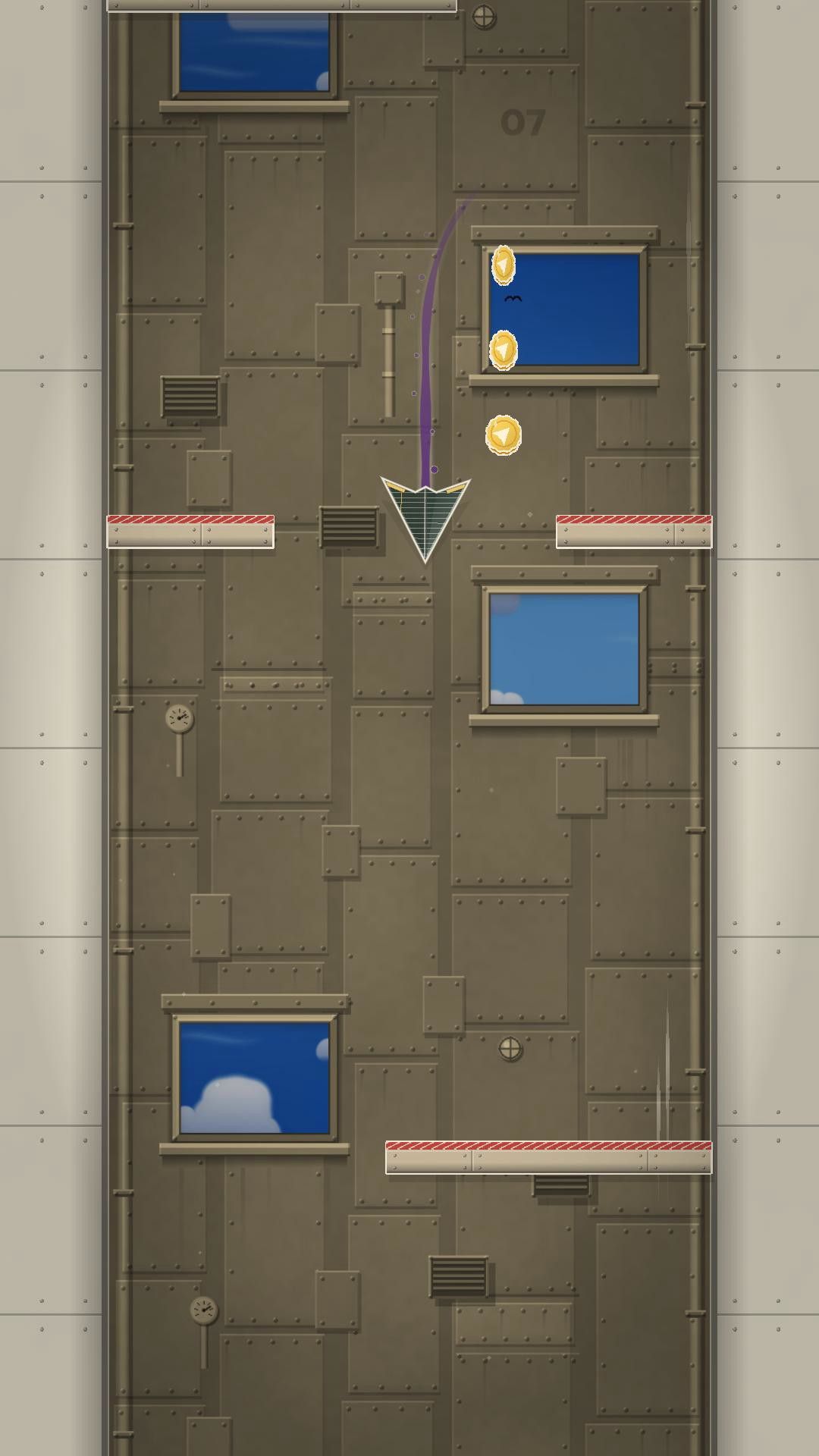
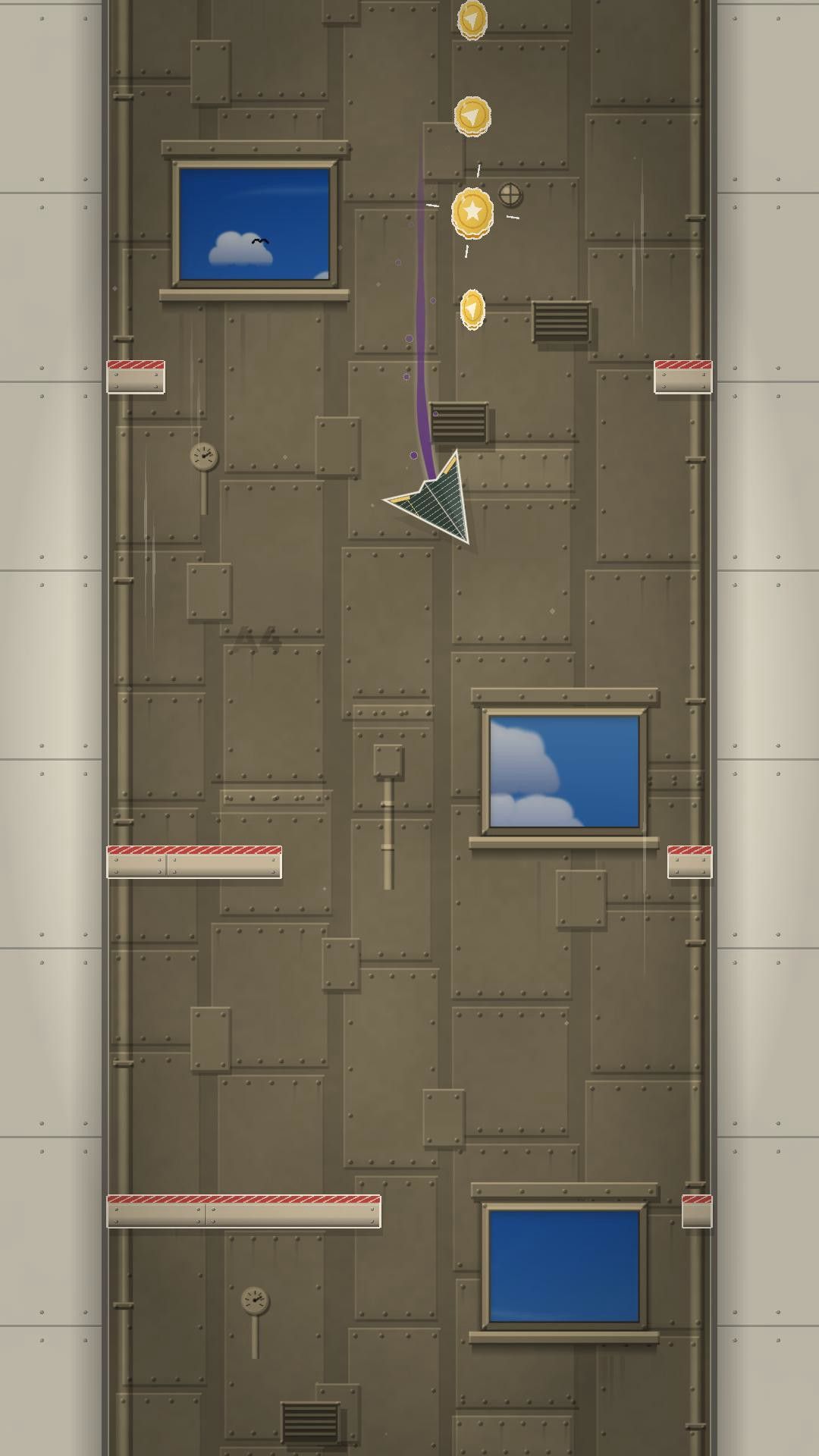
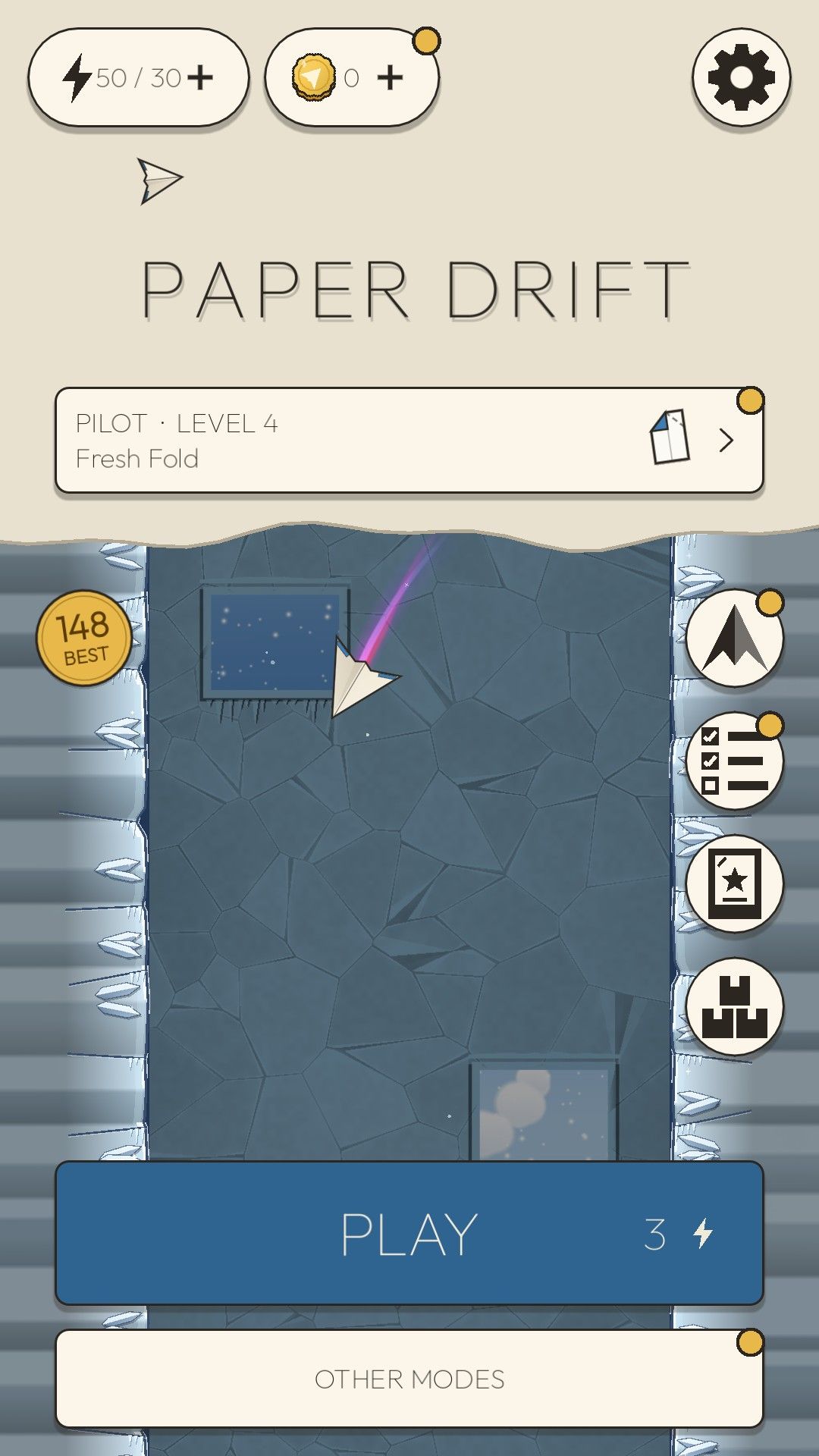
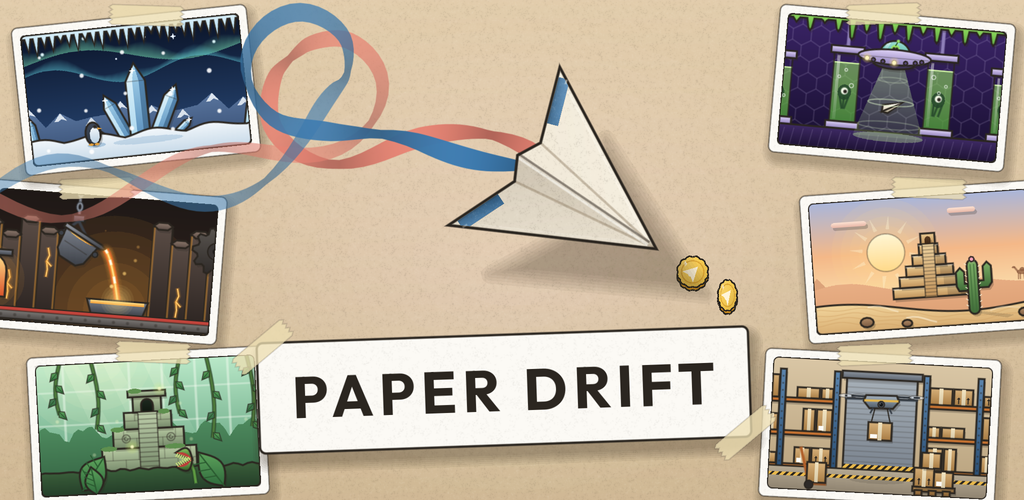
In Paper Drift, a free arcade game for Android and iPhone, you steer a folded paper plane down an endless shaft of girders, and it flies by rules you now know. Fly level and it dives faster; bank and it slows its fall. Walls only scuff it; beams end the run. If you want to see what makes a flying game with a paper plane feel right, read what makes a great paper plane game, or jump straight into the Paper Drift beginner’s guide. Every world the shaft passes through, from the paper factory to the ice of the Glacier, is on the worlds page.
Questions
What is the best paper for a paper airplane?
Plain 75–80 g/m² (20 lb) printer paper in A4 or US Letter size. It holds a sharp crease and is light enough to glide. Card and photo paper are too heavy and too stiff to fold cleanly.
Why does my paper airplane nose-dive?
The nose is pulling it down. Bend the back edge of both wings up by a millimetre or two, and throw a little more gently and level. Check that the wings are not drooping below the body.
Why does my paper airplane turn to one side?
Usually one wing is bigger, bent or twisted. Make the wings match first. If it still pulls left, bend the back edge of the right wing up a touch; if it pulls right, bend the back edge of the left wing up.
How do I make a paper airplane fly farther?
Crease every fold sharply, keep both wings identical, open them to a shallow V and throw smoothly with the nose slightly above the horizon. Then trim with tiny bends until it glides straight.
Is there a paper airplane game on mobile?
Yes. Paper Drift is a free arcade game for Android and iPhone where you steer a folded paper plane down an endless shaft of girders. Runs are short, retry is instant and it plays without an internet connection.